
Florida homeowner education
Amendment 3 and Your Homestead
What Florida voters should know before November 3, 2026.
This plain-language guide explains what exists today, what the proposal would change, and what it could mean for homesteaded and non-homesteaded property.
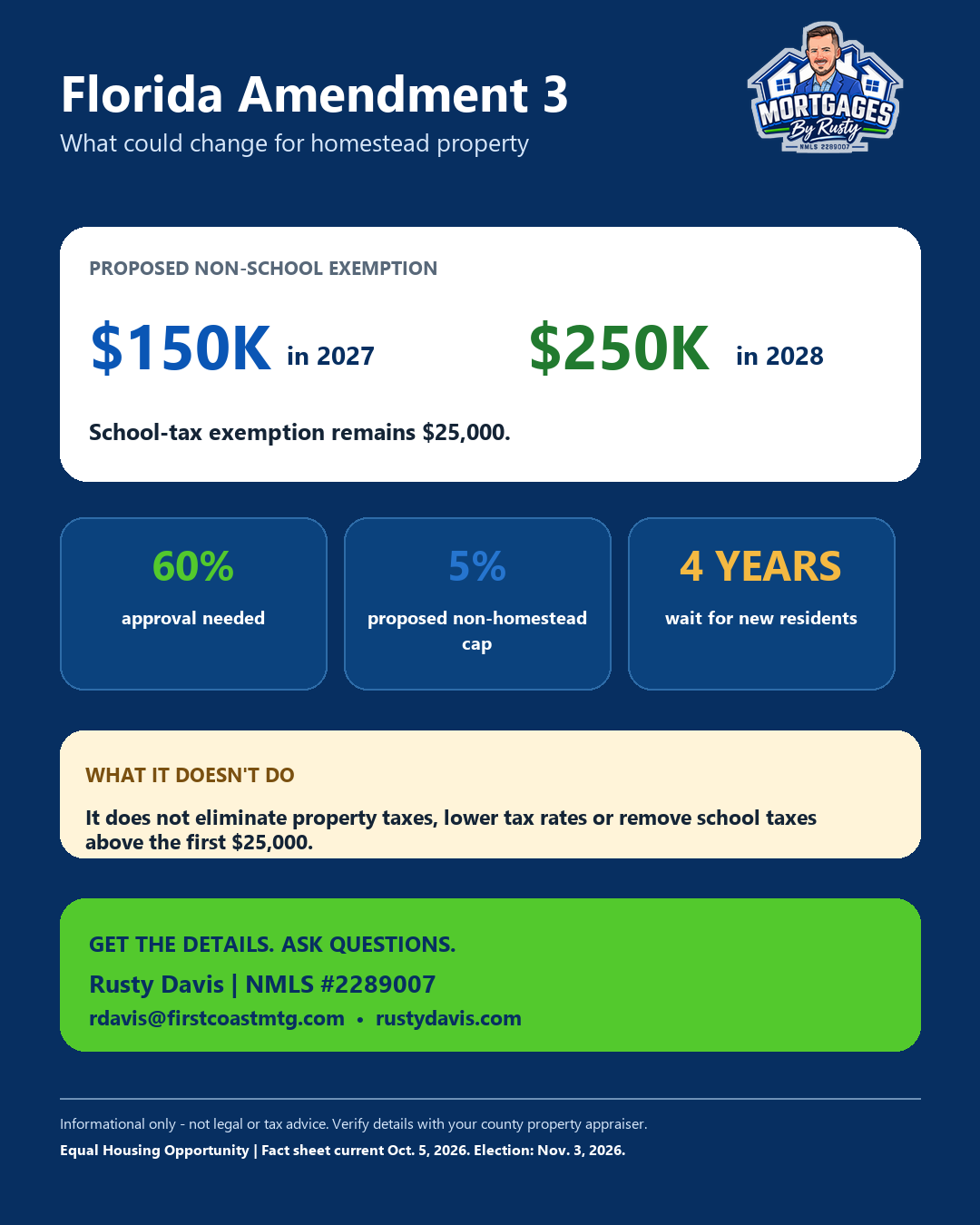
Current Florida law remains in place unless at least 60% of voters approve Amendment 3 in the November 3, 2026 General Election.
On the ballot
The official ballot title
Increased Homestead Exemption; Lower Cap on Increases in Non-Homestead Property Assessments
If approved, Amendment 3 would take effect January 1, 2027.
Current law
How Florida homestead works today
If you own a Florida home and it is your permanent residence as of January 1, you may qualify for the homestead exemption. For the 2026 tax year, the maximum exemption is $51,411.
All property taxes
The first $25,000 of assessed value is exempt from all property taxes, including school taxes.
Non-school taxes only
An additional inflation-adjusted exemption applies to non-school property taxes.
The exemption reduces taxable value. It does not change the tax rates set by local taxing authorities.
Existing protections would remain
Save Our Homes: Annual increases in a homesteaded property's assessed value are generally limited to 3% or inflation, whichever is lower.
Portability: Eligible owners may transfer up to $500,000 of accumulated Save Our Homes assessment difference to another Florida homestead, subject to the rules and deadlines.
Other exemptions: Existing senior, veteran, widow, widower and disability exemptions would not change.
The proposal
Five changes voters are considering
A larger exemption for non-school property taxes
The school tax exemption would remain $25,000. The total exemption for non-school taxes would rise to as much as $150,000 in 2027 and $250,000 in 2028, with inflation adjustments beginning in 2029.
A possible path to a larger local exemption
The Legislature would establish a uniform process for counties and municipalities to increase the exemption for their own levies, potentially up to a homestead's full assessed value. Special districts could do so with voter approval. The amendment itself does not set an additional amount or timetable.
Different timing for newer Florida residents
A person who is not a permanent Florida resident on December 31, 2026 would initially receive the existing exemption after qualifying for homestead. The larger exemption would begin in the fifth year of exemption, to the extent allowed by the U.S. Constitution.
A lower assessment cap for non-homestead property
The annual assessment increase cap for rentals, second homes and many commercial properties would fall from 10% to 5% for non-school taxes. This limits how quickly assessed value can rise; it does not reduce the existing value or provide a homestead exemption.
Rules for local property tax revenue
The ballot summary identifies public safety, education, infrastructure, natural resources, debt service, employee retirement benefits, and operations and administration as authorized uses. It also allows other expenditures approved by county officers or local governing bodies unless prohibited by general law.
At a glance
How the exemption would change
| Tax year | School tax exemption | Non-school tax exemption |
|---|---|---|
| 2026, current law | $25,000 | Up to $51,411 total |
| 2027, if approved | $25,000 | Up to $150,000 |
| 2028, if approved | $25,000 | Up to $250,000 |
| 2029 and later | $25,000 | Maximum adjusted for inflation |
The larger exemption would apply only to non-school property taxes and cannot reduce taxable value below zero.
Real numbers
Three examples using taxable value
These examples show taxable value, not the final tax bill. Actual taxes depend on local millage rates, assessments, fees and any other exemptions that apply.
Example 1
$350,000 homesteaded home
Assume the owner is eligible for the larger exemption and has no Save Our Homes assessment difference.
- 2026 non-school taxable value
- $298,589
- 2027 if approved
- $200,000
- 2028 if approved
- $100,000
- School taxable value, all years
- $325,000
Example 2
$400,000 rental property
The property receives no homestead exemption. If the assessed value were otherwise eligible to rise by the maximum amount in one year:
- Current 10% cap
- Up to $40,000
- Proposed 5% cap
- Up to $20,000
The cap does not apply to school tax assessments.
Example 3
$600,000 home for a new Florida resident
- 2027 taxable value if resident by Dec. 31, 2026
- $450,000
- 2027 taxable value if resident Jan. 1, 2027 or later
- $550,000
- School taxable value
- $575,000
The newer resident's initial exemption adjusts for inflation beginning in 2028. The larger exemption begins in the fifth year.
Important limits
What Amendment 3 would not do
- It would not eliminate all property taxes.
- It would not eliminate school property taxes above the first $25,000 of assessed value.
- It would not lower local millage rates.
- It would not reduce fire, stormwater, community development district or other non-ad valorem assessments.
- It would not change Save Our Homes, portability or existing additional exemptions.
- It would not give rentals, second homes or commercial properties a homestead exemption.
- It would not guarantee a particular funding level for police, fire or emergency medical services.
Both perspectives
What supporters and opponents say
Supporters
Supporters argue that Florida homeowners need meaningful relief from rising property tax bills. They say a larger homestead exemption would reduce taxable value for many primary residences, while the lower non-homestead cap would slow assessment increases for rentals, second homes and many commercial properties.
Opponents
Opponents argue that the proposal would significantly reduce revenue available to counties, cities and special districts. They warn that local governments could face service reductions, higher fees or pressure to shift costs elsewhere.
The Florida House final analysis reported estimated reductions in local non-school property tax revenue of approximately $4.95 billion in fiscal year 2027 to 2028 and $8.78 billion in fiscal year 2028 to 2029, reaching an estimated recurring annual impact of approximately $11.86 billion once fully phased in.
Calendar
Key dates
Election Day
Florida voters decide Amendment 3. The proposal needs at least 60% approval to pass.
Residency cutoff
The amendment uses this date to determine when a qualifying homeowner may receive the larger exemption.
First changes
If approved, the non-school homestead exemption rises to as much as $150,000 and the non-homestead assessment cap falls to 5%.
Application deadline
The standard homestead application deadline remains unchanged.
Second increase
The non-school homestead exemption rises to as much as $250,000 for eligible homeowners.
Inflation adjustments
Annual inflation adjustments to the maximum exemption begin.
If the amendment does not receive 60% approval, these proposed changes will not take effect and current law will continue.
Your property
Where to verify your information
Every property and tax bill is different. Your county property appraiser can confirm assessed value, exemptions and homestead status. Local taxing authorities determine millage rates, and the tax collector issues the final bill.
Some implementation details would be established through legislation if the amendment passes. Use the official resources below for the latest information.
Mortgage planning
Want to talk through how this could affect your housing costs?
I can help you think through a purchase, refinance or escrow question. For property-specific exemption and assessment guidance, contact your county property appraiser.
This article summarizes current Florida law and a proposed constitutional amendment using public sources available as of October 13, 2026. It is not a recommendation on how to vote and is not legal, tax or financial advice. Property tax amounts depend on assessed value, exemptions, millage rates, non-ad valorem assessments and other factors. Verify details for a specific property with the appropriate county property appraiser and consult qualified legal or tax professionals when needed.
First Coast Mortgage Funding LLC, Company NMLS #1953441. Rusty Davis, NMLS #2289007. Equal Housing Opportunity.